
Transforming UX Improvement Through AI Automation
Phoenix
The Beginning: Paper Cuts Program
In Q4 2022, I launched the Paper Cuts Program to address a growing challenge across the AWS Billing and Cost Management (BCM) Console: small but impactful customer experience issues that were being identified faster than engineering teams could resolve them. These weren't bugs, but rather localized UI inconsistencies like confusing button labels, unclear error messages, spacing issues, and deviations from the Cloudscape design system.
The program was built on three core principles:
Quick wins: Prioritizing low-effort, high-impact fixes completable within a single sprint
Team autonomy: Empowering teams to decide what to fix and how to prioritize
Celebrate success: Highlighting resolved issues and recognizing contributors
While the program paused in 2023 due to team attrition, we relaunched it in Q1 2025 with a focused pilot across three key areas and targeting 29 improvements from our backlog of 72 identified issues.
The Challenge: A Growing Bottleneck
Despite strong leadership support and clear identification of UX improvements, we faced two critical challenges:
Resource Constraints: Engineering teams struggled with competing priorities. While teams recognized the importance of addressing UX improvements, design debt consistently got deprioritized in favor of urgent fires and major feature initiatives. As of August 2025, we had identified over 90 UI issues but resolved only 11, a stark implementation bottleneck.
Manual Process Inefficiency: The workflow required extensive manual effort, 60-90 minutes per issue for visual inspection, documentation, and implementation coordination. Across 40 BCM pages, this translated to 125 hours of manual work monthly.
This systematic deprioritization created a growing backlog of issues that, while individually small, collectively degraded the customer experience at scale. The gap between our intentions to improve and our capacity to execute demanded an automated solution.
What was I going to do about this??
The Solution: Phoenix
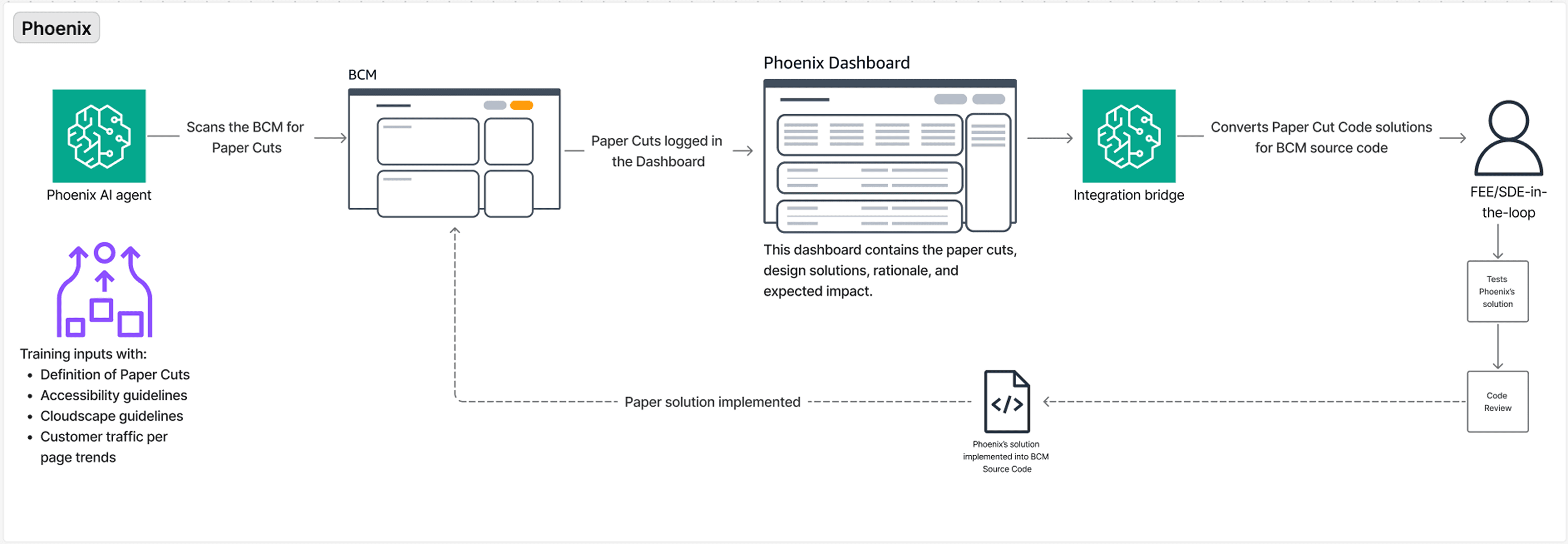
The Paper Cuts bottleneck arose right alongside with AWS' release of Kiro, which sparked an idea. I put on a developer hat and created Phoenix as an AI-powered system that transforms the manual Paper Cuts Program into an automated pipeline, bridging the divide between issue identification and resolution.
While there are existing internal tools to identify and fix component-level issues, Phoenix expands this capability by detecting UI component inconsistencies, visual design issues, accessibility violations, Cloudscape compliance issues, user flow disruptions, and documentation errors and the pièce de résistance: automatically generating implementation-ready solutions!
Phoenix automates the entire workflow through five key components:
Detection System: Computer vision and pattern recognition algorithms monitor the BCM interface to identify UI inconsistencies in real-time
Analysis Engine: LLM processs findings to evaluate impact and generate design and code solution specifications
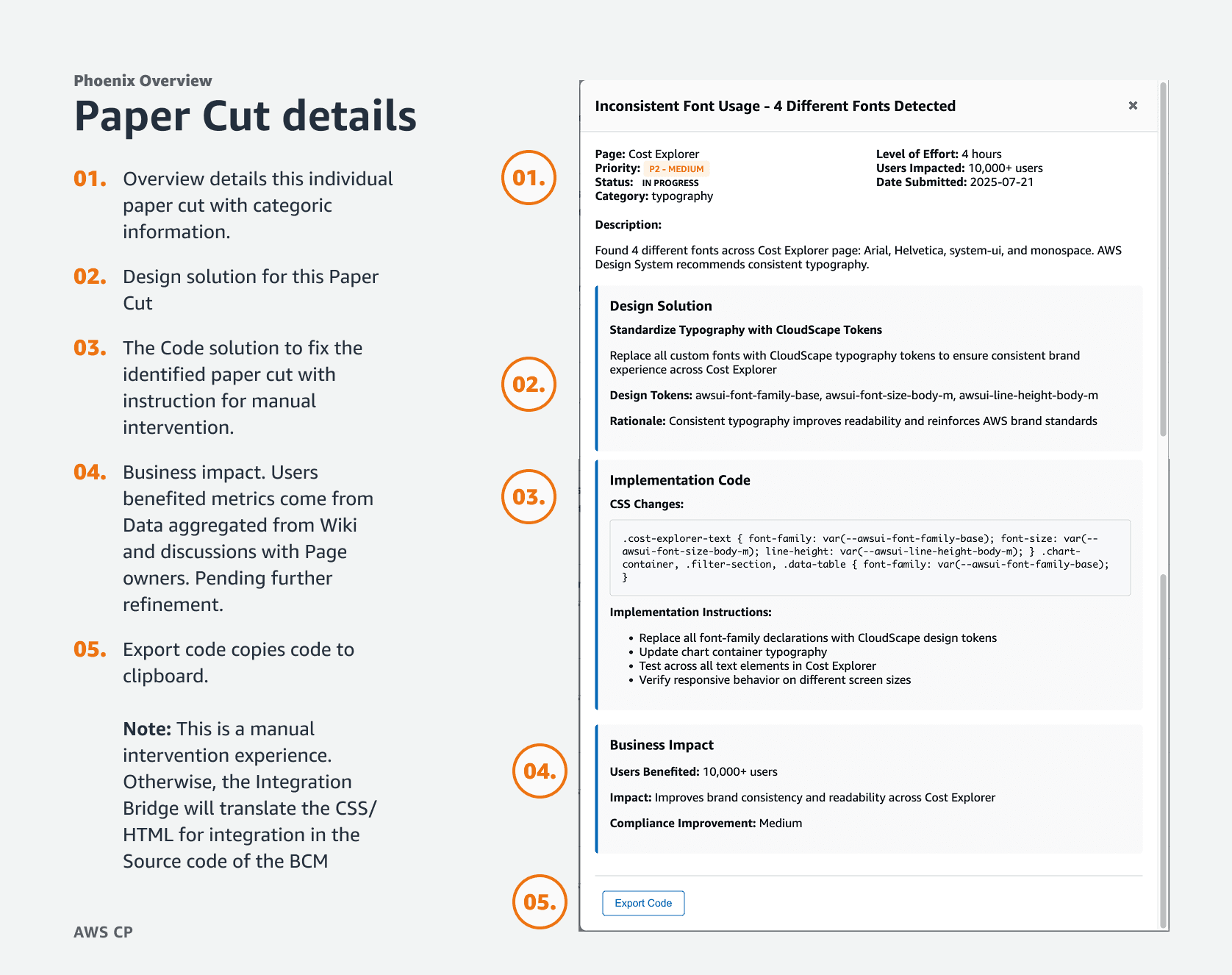
Solution Generator: Creates design solutions and implementation-ready code, reducing technical overhead by 80%
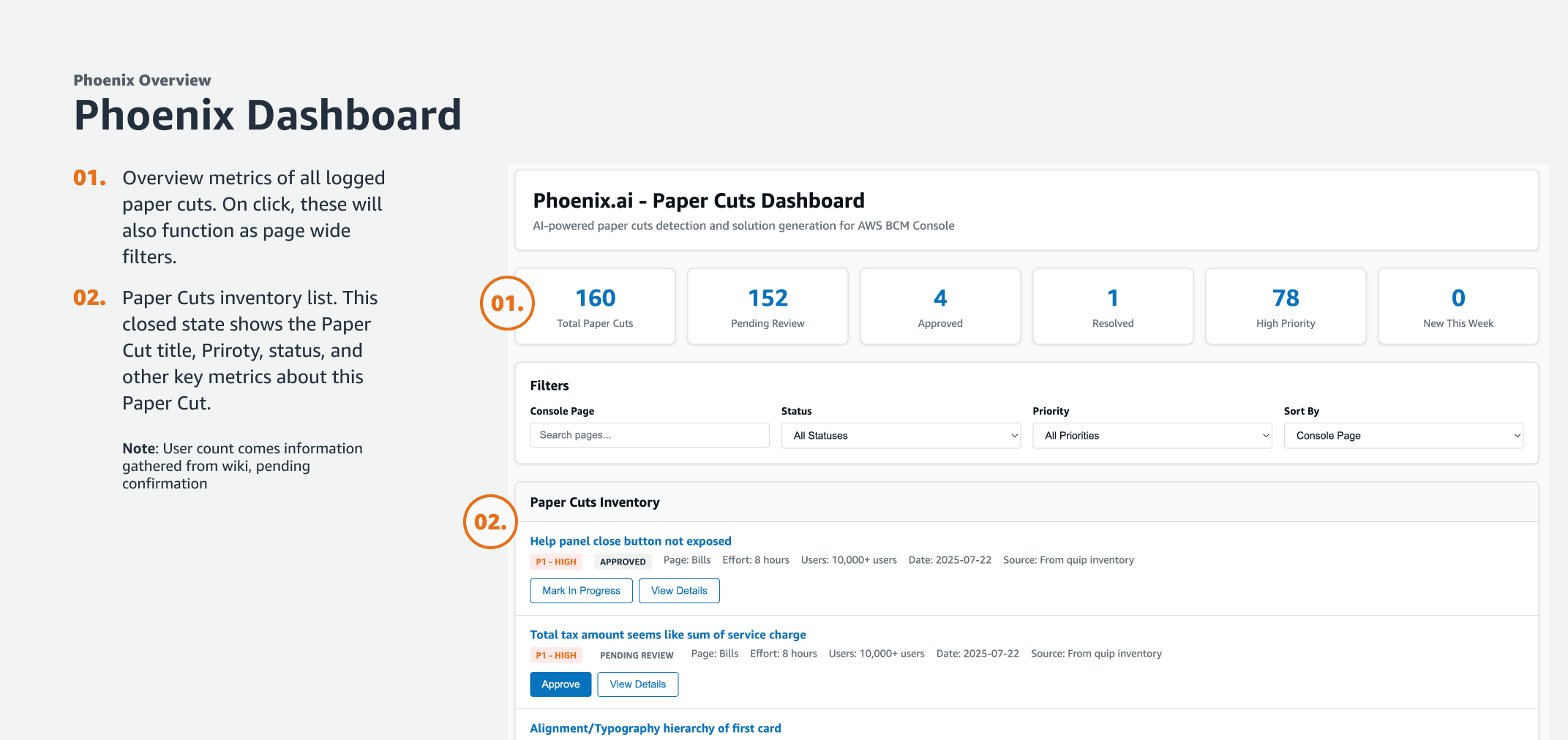
Dashboard: A central interface displaying data on issues, solutions, severity, and implementation status
Implementation System: Automated deployment for lower-severity issues (3-5), with human approval required for critical issues (1-2)
The system maintains AWS quality standards through strategic human oversight, following the AWS Severity Framework to ensure critical issues receive appropriate review before implementation.
Where We Are Now: Validation and Progress
I have a working prototype on my local machine and have been actively sharing Phoenix with leaders in my direct orgnization; Phoenix has gained significant traction and excitement with approval for funding and a pilot launch.
During my time building Phoenix out, I have created three phases on my road to a formal pilot and testing in a production environment. Here is what happened so far and what I have coming up
Phase 1: Foundation (Completed)
Built core AI detection engine with multi-page scanning capability in Kiro
Developed comprehensive dashboard for issue management
Established database schema and API architecture with Kiro and support from an engineer
Achievement: 160+ paper cuts discovered and catalogued across the BCM Console
Phase 2: Integration Bridge (Completed)
Designed and implemented code translation engine
Built component mapping system (CloudScape → AWS internal)
Developed automated code generation saving engineering work time leading up to CodeReview
Achievement: Complete pipeline from AI detection to code generation
Phase 3: Validation and Testing (Current)
Tested and validated proof-of-concept workflow for internal BCM pages
Milestone: Successfully completed first end-to-end paper cut resolution: identifying, designing, developing, and fixing an accessibility violation for color contrast in Cost Explorer on a local machine
The Impact. What's the point?
I see building Phoenix as a win-win. As the owner of the Paper Cuts program, I saw a lack of progress in the roll out of Paper Cut solutions. This couldnt slide because a key measure of success for the program is Paper Cut resolutions. upon diving deeper, I find out that the pile in our engineering partners backlog is herculean.
So what else to do than spend time innovating. The expected benefits from launching Phoenix would be:
Processing time: From 60-90 minutes to 12-18 minutes per paper cut
Monthly effort: From 125 hours to approximately 25 hours
Implementation time: From 2-3 days to 2-3 hours per fix
This efficiency frees up valuable engineering and design resources while maintaining the core principles of the original Paper Cuts Program: quick wins, team autonomy, and celebration of improvements.
Next Steps: Moving to Production
As I continue refining Phoenix and sharing it with leaders at my organizations level and beyond, I have a vision for getting it to production. For the sake of confidentiality in my rollout process, here is a high level overview, happy to share more with you over a call if you want to learn more! The following are my next steps to bringing Phoenix into production at AWS:
Continued testing: Validating more paper cuts across the 4 pilot pages
SDE partnership: Securing dedicated engineering support with BCM console integration access and expertise
Production testing: Pushing changes to a test accounts to validate fixes in production environment
Pilot Expansion: Once validated, extending Phoenix across all BCM pages → other AWS consoles → enterprise wide! (dreaming big to see where this goes)
To me Phoenix represents more than just automation, it's a fundamental shift in how we approach UX improvement at scale. I think the future is not to automate out anyone in this process. Contrasting the way the industry is heading, I am a strong opponent of AI replacing any roles. It does not make sense. But I see strong opportunity to use AI capabilities with strategic human oversight to simplify existing workflows to create more time for teams to focus on larger strategic initiatives.
The journey from Paper Cuts to Phoenix demonstrates how my process in identifying the right problem, understanding the constraints, and applying AI thoughtfully can transform a well-intentioned program into a scalable, automated solution that delivers real impact for our customers. Wish me luck as I scale this!
Get in touch! aarushg@gmail.com